How to Find the Cheapest Claude API for Your Projects
Developers looking to integrate Claude into their applications often face a common puzzle: how to get the best price without sacrificing reliability. The official API from Anthropic sets a clear baseline, but depending on your usage patterns, that baseline may not be the most economical option. The search for the cheapest Claude API can lead you to some interesting alternatives, and one of them involves a marketplace model that routes your requests through competitive sellers.
Before you dive into the options, it helps to understand how API pricing actually works for large language models. The costs are typically measured per token, with separate rates for input and output tokens. On top of that, some providers add platform fees, charge for caching, or require minimum commitments. So when you are comparing prices, you have to look at the total cost per request, not just the per-token rate. This is where the cheapest Claude API uberllm can make a real difference, because it bundles access through a system that lets multiple sellers compete for your traffic.
Why a Marketplace Model Can Lower Costs
Traditional API access means you buy from a single provider at their listed price. That provider sets a margin, and you either pay it or you don't use the model. A marketplace flips that dynamic. Instead of one seller, you have several independent operators who each bring their own infrastructure and pricing. They compete on cost because they want your business. The platform itself provides a unified key and handles the routing logic, so you never have to manage multiple accounts or worry about which seller is cheapest at any given moment.
This competitive routing is the core mechanism behind the cheapest Claude API uberllm approach. The system automatically selects the seller offering the lowest price for your request, and you only pay that price. The result is that your effective rate can fall below the official list price, sometimes significantly. For high-volume users, even a small per-token saving adds up fast. But it is not just about raw cost. The same marketplace can offer redundancy: if one seller goes down, another picks up the traffic, so your uptime can actually improve compared to a single-provider setup.
What to Check Before You Choose a Provider
When you are evaluating any API provider, especially one that claims to offer the cheapest Claude API, you need to verify a few things beyond the price tag. Latency is a big one. A cheap route that adds seconds to every response might not work for a real-time chat application. Throughput matters too: some providers cap the number of requests per minute or per day, which can throttle your project during peak usage.
Another factor is model version support. Claude comes in several variants, from the fast and affordable Haiku to the powerful Opus. Not every seller on a marketplace will support every version. Make sure the platform you choose can access the specific Claude model your application needs. Also check whether the marketplace supports features like streaming, function calling, or structured output. If your use case depends on those, a bare-bones API endpoint may not be enough.
Security and Data Handling
When you route API calls through a third-party marketplace, your data passes through their infrastructure. It is important to understand how that data is handled. Does the platform log your prompts? Do the sellers have access to the content of your requests? Reputable marketplaces have clear policies about data retention and privacy. Some offer enterprise-grade security with encryption in transit and at rest. If you are handling sensitive user information, you will want to confirm that the marketplace does not store or inspect your payload beyond what is necessary to fulfill the request.
Comparing the Cheapest Claude API Options
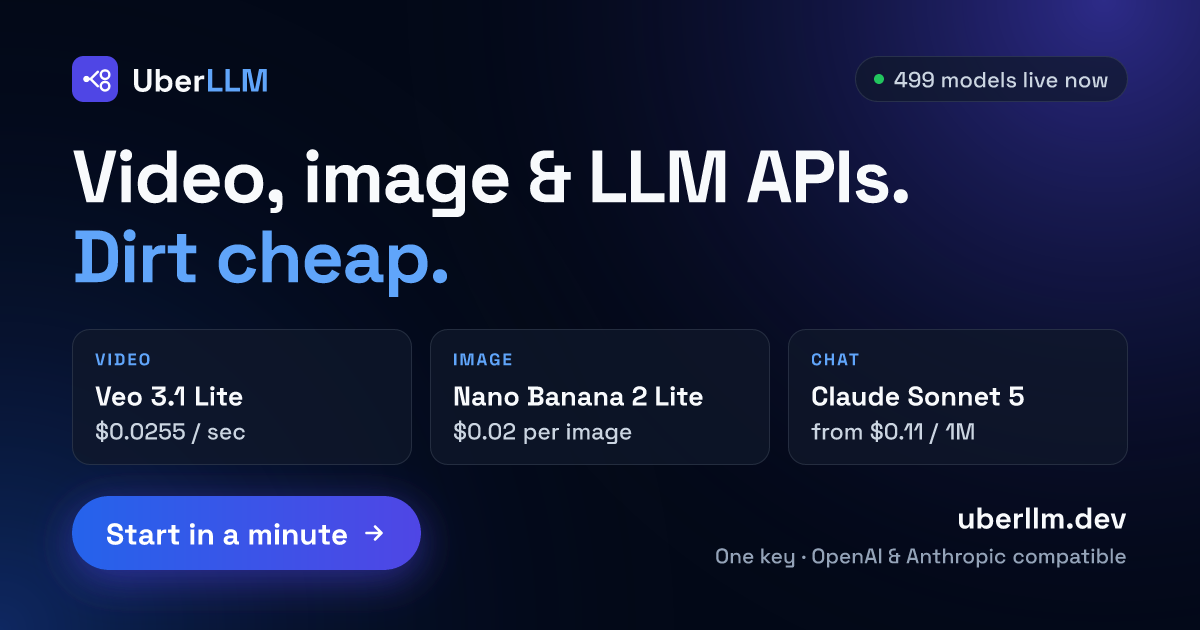
Let us walk through a typical comparison. You have the official Anthropic API, which is simple and well-documented. You have a few large resellers that offer discounted rates if you commit to a certain volume. And then you have a marketplace like UberLLM that aggregates multiple sellers. The official API is the most straightforward, but it is also the most expensive per token for most use cases. Resellers can offer discounts, but they often require a monthly minimum or a prepaid balance.
The marketplace approach, on the other hand, can give you the cheapest Claude API without any minimum commitment. You pay as you go, and the competitive routing ensures you are always getting the lowest available price from a pool of sellers. The trade-off is that you have less direct control over which seller handles each request. If a particular seller has a brief outage, your request might fail or get retried, though good marketplaces handle this transparently with fallback logic.
Practical Scenarios Where It Shines
For a developer building a prototype or a small-scale application, the cost savings from the cheapest Claude API uberllm might be modest at first. But as your user base grows, those savings compound. Imagine you are running a customer support chatbot that processes thousands of conversations a day. Even a small percentage reduction in per-token cost can save you hundreds of dollars a month. That is money you can reinvest into improving your product or hiring more team members.
On the flip side, if your project is latency-sensitive and every millisecond counts, you might need to test whether the marketplace routing adds any noticeable delay. In many cases, the routing decision happens in a few milliseconds, and the actual model inference time dominates the total latency. But it is worth benchmarking with your own workload before you commit.
How to Get Started
Getting access to a competitive marketplace API is usually as simple as signing up for an account and generating an API key. You then point your existing code at the new endpoint, and the marketplace takes care of the rest. Most platforms offer SDKs or example code for popular programming languages. The integration effort is typically low, often just a matter of changing the base URL and authentication header in your API calls.
Once you are set up, you can monitor your usage and costs through the platform's dashboard. Some marketplaces let you see which sellers handled your requests and at what price. That transparency is helpful if you want to audit the savings or adjust your routing preferences. Over time, you can build a sense of which sellers are most reliable and adjust your configuration accordingly, though the best platforms automate that optimization for you.
Final Thoughts on Value
The cheapest Claude API is not just about the lowest number on a pricing page. It is about the total value you get for what you pay. Reliability, speed, model support, and ease of integration all factor into that equation. A marketplace model can deliver on all those fronts while still offering competitive pricing, because it shifts the burden of competition onto the sellers rather than onto you as the developer.
If you are currently paying list price for Claude access, it is worth exploring whether a marketplace like UberLLM can lower your costs without compromising quality. The key is to test it with your own traffic patterns and see how it performs. For many teams, the switch is straightforward and the savings are immediate. And as the ecosystem of AI models continues to expand, having a single key that can route to the cheapest provider at any given moment will only become more valuable.